Colon and Rectum
Megacolon and Ogilvie's Syndrome
Megacolon is a general term for an abnormally dilated colon, which can be acute, as seen in Ogilvie's syndrome (pseudo-obstruction), or chronic.
Reviewed by Allen Kamrava, MD, MBA, FACS, FASCRS · Last reviewed 2025-10-12
Overview
What is megacolon?
Megacolon is a general term describing a severely dilated large intestine (colon) that is not caused by a mechanical blockage. This dilation can be acute or chronic and can affect a segment of the colon or the entire colon. The enlarged colon has impaired motility, leading to the accumulation of gas and stool.
Ogilvie's Syndrome, also known as acute colonic pseudo-obstruction (ACPO), is a specific type of acute megacolon. It is a serious condition that typically occurs in hospitalized patients who are ill from another medical or surgical problem. It involves a massive dilation of the colon without any actual physical obstruction. The underlying cause is thought to be a disruption of the autonomic nervous system that controls colon motility. If not decompressed, the colon, especially the cecum, can dilate to a point where it is at risk of perforating, which is a life-threatening emergency.
Symptoms
What are the symptoms?
The primary symptom of Ogilvie's syndrome is significant abdominal distension that develops over a few days. Other symptoms include:
- Abdominal pain, which may be mild or crampy.
- Nausea and vomiting.
- Inability to pass stool or gas (obstipation), although some patients may continue to pass small amounts of liquid stool or gas.
- Fever and abdominal tenderness may develop if the colon becomes ischemic or perforates.
Causes & risk factors
What causes Ogilvie's Syndrome?
The exact cause of Ogilvie's syndrome is not fully understood, but it is believed to result from an imbalance in the autonomic nervous system that regulates the colon's muscular contractions. This leads to a functional paralysis of the colon. The condition is almost always seen in patients who are already hospitalized with a serious underlying illness or who have recently undergone surgery.
Common associated conditions and risk factors include:
- Recent surgery: Especially orthopedic (hip or knee replacement), pelvic, or cardiac surgery.
- Serious medical illness: Such as pneumonia, sepsis, heart attack, or kidney failure.
- Trauma or burns.
- Neurological conditions: Such as spinal cord injury, Parkinson's disease, or stroke.
- Electrolyte imbalances.
- Certain medications: Opioids and anticholinergic drugs are common culprits.
When to see a doctor
When should I seek care?
Ogilvie's syndrome is a condition that occurs in hospitalized patients. The diagnosis is usually suspected by the medical team when a patient develops significant abdominal distension. Any patient experiencing severe bloating and inability to pass gas or stool, especially in the context of a recent surgery or severe illness, needs immediate medical evaluation to determine the cause.
Urgent — get care now
When is it an emergency?
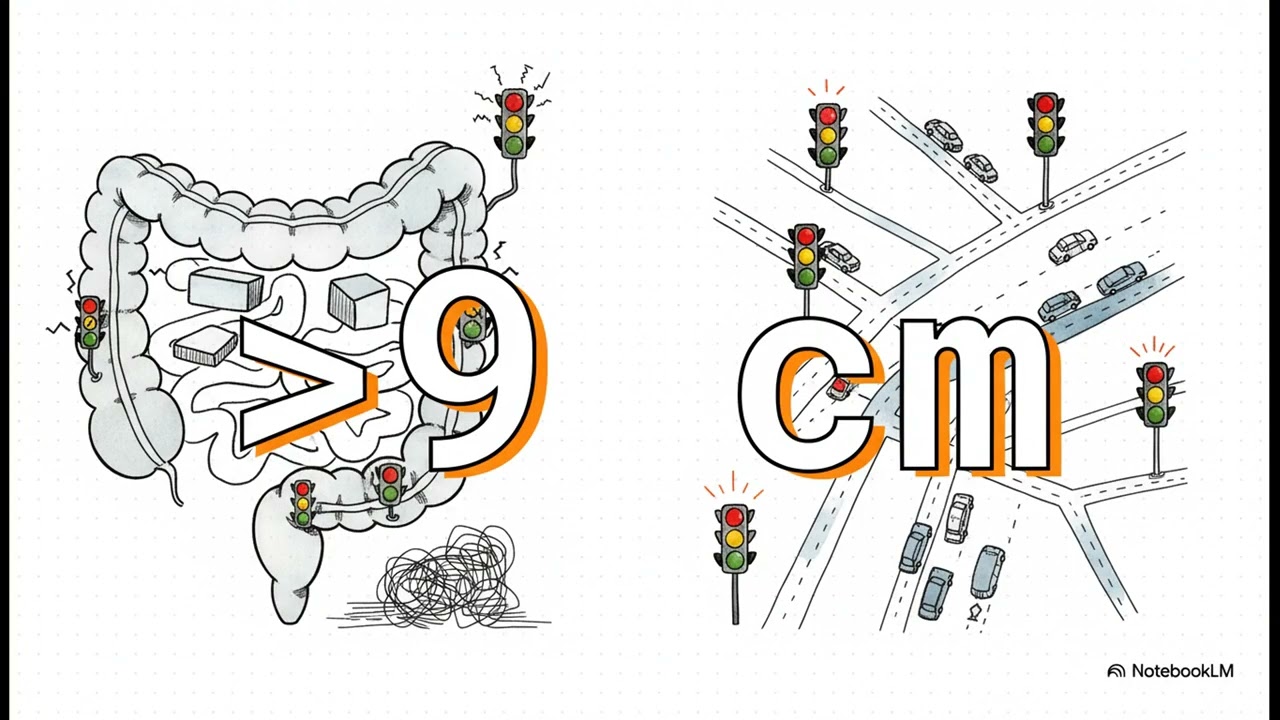
Ogilvie's syndrome is an urgent condition that can become a life-threatening emergency. The greatest danger is perforation of the colon. As the colon dilates, the tension in its wall increases, which can compromise blood flow, leading to ischemia and tissue death (gangrene). A cecal diameter greater than 10-12 cm on an X-ray is often considered a sign of impending perforation. Any patient with Ogilvie's syndrome who develops signs of peritonitis (severe, constant pain and a rigid abdomen) or sepsis (fever, rapid heart rate, low blood pressure) requires emergency surgery.
Diagnosis & tests
How is Ogilvie's Syndrome diagnosed?
The diagnosis is made with imaging studies, after a mechanical obstruction has been ruled out.
- Abdominal X-ray: This is often the first test and will show massive dilation of the colon, particularly the right and transverse colon.
- CT Scan: A CT scan of the abdomen and pelvis is the most important test. It confirms the colonic dilation, can accurately measure the diameter of the cecum, and, most importantly, can rule out a mechanical blockage as the cause of the dilation. A CT scan can also show signs of complications like ischemia or perforation.
- Water-soluble contrast enema: This may be used in some cases if the CT scan is equivocal, to definitively rule out a mechanical obstruction in the distal colon.
Treatment
How is Ogilvie's Syndrome treated?
The goal of treatment is to decompress the colon to prevent perforation. The approach is typically stepwise, starting with conservative measures.
- Conservative Management: The initial treatment involves stopping any contributing medications (like opioids), treating the underlying medical condition, correcting any electrolyte abnormalities, and keeping the patient from eating or drinking (NPO). Patients may be encouraged to change positions in bed to help move gas through the colon. This is successful in a majority of patients if the cecal diameter is not excessively large.
- Pharmacologic Decompression: If conservative measures fail after 24-48 hours, or if the cecum is massively dilated, a medication called neostigmine is often used. Given intravenously under cardiac monitoring, neostigmine stimulates colonic contractions and can lead to a rapid and dramatic decompression of the colon in most patients.
- Endoscopic Decompression: For patients who do not respond to or cannot receive neostigmine, colonoscopy can be performed to decompress the colon. A decompression tube may be left in place to help keep the colon from re-dilating.
- Surgery: Surgery is reserved as a last resort for patients who fail all other treatments, or for those who have signs of ischemia or perforation. The most common procedure is a cecostomy, where a tube is placed through the abdominal wall directly into the cecum to allow for continuous decompression. If a portion of the colon is gangrenous or perforated, that segment must be removed, which often results in a colostomy.
Frequently asked questions
Is Ogilvie's Syndrome the same as toxic megacolon?
No. While both are forms of acute megacolon, their causes are different. Ogilvie's syndrome is a non-inflammatory condition caused by a motility disorder. Toxic megacolon is a life-threatening complication of severe inflammation, most often seen in patients with ulcerative colitis or C. difficile colitis, where the inflammation extends deep into the muscle layers of the colon.
Can Ogilvie's Syndrome happen to someone who is not in the hospital?
It is extremely rare for Ogilvie's syndrome to occur in an otherwise healthy person outside of the hospital setting. It is almost exclusively a complication of another serious medical or surgical problem.
References
- Feingold, D. L., & Fleming, F. J. (2022). Large Bowel Obstruction. In S. R. Steele, T. L. Hull, N. Hyman, J. A. Maykel, T. E. Read, & C. B. Whitlow (Eds.), The ASCRS Textbook of Colon and Rectal Surgery (4th ed., pp. 681-697). Springer.
- Cleveland Clinic. Ogilvie Syndrome (Acute Colonic Pseudo-Obstruction). Accessed September 28, 2026. https://my.clevelandclinic.org/health/diseases/17141-ogilvie-syndrome
- Mayo Clinic. (2021, August 12). Ogilvie's syndrome. Retrieved October 12, 2025, from https://www.mayoclinic.org/diseases-conditions/ogilvies-syndrome/symptoms-causes/syc-20375740